 The reality is not what it seems
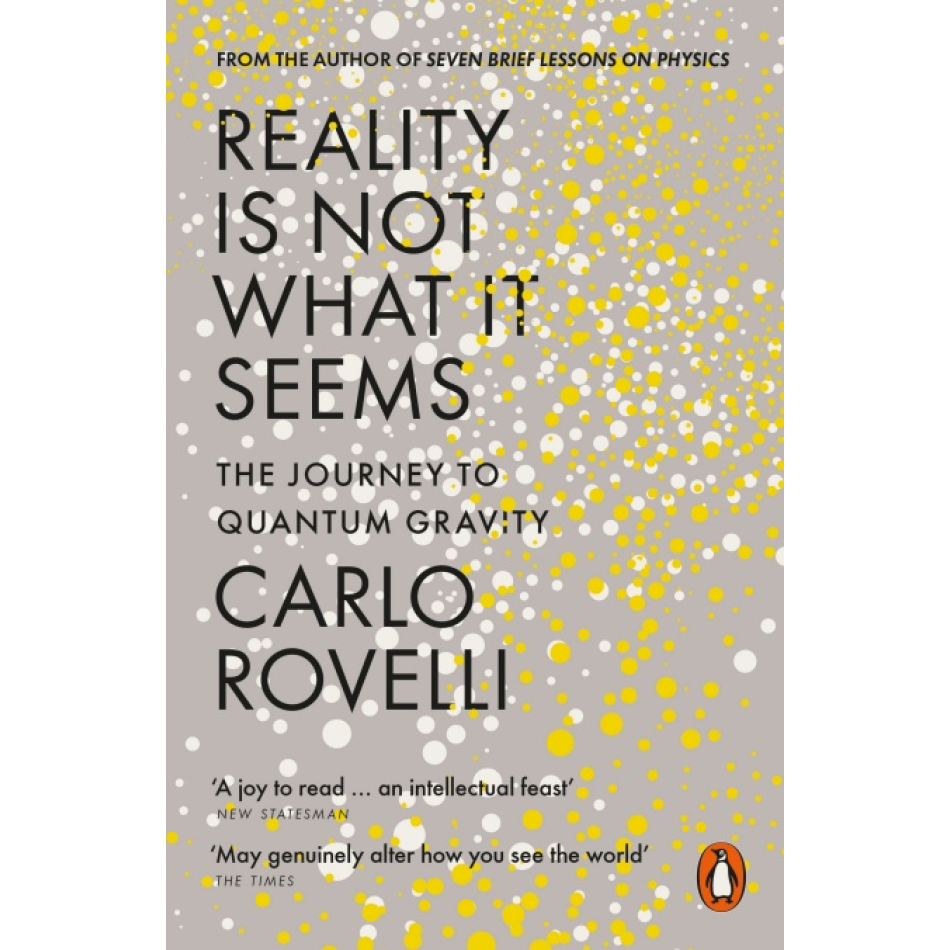 |
| The reality is not what it seems |
 
|
 كتاب اليوم كتاب اليوم |
| أضيف بواسطة RAWAN |
From an early age, we grow accustomed to a simple image of reality. We see solid objects around us, occupying clear positions in space, persisting through time. This image feels unquestionable because it aligns with daily experience. A table remains where it is. A stone stays solid in the hand. Time appears to flow forward, second after second. Yet physics, when followed carefully, leads us away from this familiar ground and into a far more subtle understanding of the world.
Rovelli begins by revisiting classical physics, not to glorify it, but to show its elegance and its limits. In Newtonian physics, the universe was governed by absolute space and absolute time. Space existed as a rigid stage, and time flowed uniformly everywhere. This framework was extraordinarily successful, allowing humanity to predict motion, build machines, and understand celestial mechanics. However, its success hid a deeper problem. It described how things moved, but not why space and time themselves should be fixed and immutable.
With Einstein, this certainty collapses. Space and time are no longer separate entities. They form a single structure, spacetime, which reacts to matter and energy. Massive objects curve spacetime, and this curvature guides motion. What we perceive as gravity is not a force in the traditional sense, but a manifestation of geometry. Time itself becomes flexible. Clocks do not all tick at the same rate. The passage of time depends on motion and gravitational fields. The idea of a universal present dissolves. There is no single moment that can be labeled “now” for the entire universe.
The book then descends into the quantum realm, where intuition fails even more dramatically. At this scale, particles do not behave like miniature versions of everyday objects. They do not possess definite properties independent of observation or interaction. A particle’s position, momentum, and energy are not fixed attributes. They are potentialities that become actual only in relation to something else. The world, at its foundation, is relational rather than substantial.
This leads to a radical shift in how we think about existence. Objects are not primary. Interactions are. What we call a thing is merely a stable pattern of relations. Even identity becomes fluid at the quantum level. Particles of the same type are indistinguishable, not just similar, but fundamentally identical in nature. The boundaries we draw between entities are approximations useful for human thought, not sharp divisions written into reality.
Rovelli then turns to the notion of emptiness. Classical intuition imagines empty space as nothingness, a passive background. Physics reveals the opposite. The vacuum is alive with activity. Quantum fields fluctuate continuously. Energy appears and disappears. Particles emerge briefly and vanish. Absolute stillness does not exist. Even in apparent silence, the universe is restless.
Time returns once more, but now stripped of its familiar role. In the equations describing the fundamental laws of nature, time often disappears entirely. The laws work equally well forward and backward. There is no preferred direction. The distinction between past and future arises not from the laws themselves, but from statistical behavior and thermodynamics. The increase of entropy gives us an arrow of time, not because time flows, but because disorder grows.
Human experience occupies a special place in this picture. Our consciousness is embedded in this thermodynamic flow. Memory works in one direction. We retain traces of the past but not of the future. Anticipation, regret, hope, and fear all depend on this asymmetry. The time we live in is real and meaningful, yet it is not fundamental. It emerges from deeper physical processes.
In the later chapters, Rovelli reflects on the nature of scientific knowledge itself. Science does not offer final truths. It offers models that work within certain domains. Each model captures aspects of reality while leaving others unexplained. Progress in physics has always involved abandoning comfortable certainties. What seems solid today may dissolve tomorrow under better understanding.
The book concludes with a profoundly human insight. To recognize that reality is not what it seems is not to fall into nihilism. It is to accept that we inhabit a universe richer and more mysterious than our instincts suggest. Meaning does not vanish when absolutes disappear. Instead, meaning arises from our participation in a changing, relational world.
|
| المشاهدات 1417 تاريخ الإضافة 2025/12/21 آخر تحديث 2025/12/21 - 18:56 رقم المحتوى 1648 |
أخبار مشابهة